

Cobalt Caldera Cliffs
Returning to Oia


“Happy is the man who, before dying, has the good fortune to sail the Aegean sea.”
– Nikos Kazantzakis


Ry in Oia in 1999. The whole family in Oia in 2025.
As we gathered on the terrace, it felt like we were standing atop a zeppelin. Blue skies all around, islands floating in the distance, the sea a thousand feet below. There were no railings or barriers impeding the view. Nothing to keep us from stumbling into the abyss of the caldera.
After a 25 year hiatus, Jen and I had returned to the improbable Greek island of Santorini. Back then, the otherworldly setting blew us away and we vowed to return one day to stay in one of the cave homes that are perilously perched atop the cliffs of the still active volcano. We were finally following through on that plan with the family in tow.
While Santorini is home to about 20,000 year round residents, the population on a peak summer day explodes to over 160,000 making it one of the most touristed destinations on earth. But much like Venice, Petra or the Grand Canyon, the sheer wonder of your surroundings is worth dealing with the global hordes.


A Volcano with Villages
Describing the setting of this island defies comprehension. It’s the remnants of a ten mile wide active volcano cone that rises 1000 feet out of the Aegean sea. The land is broken up into a crescent-shaped archipelago of five islands that surround the ancient central crater, or caldera, which is filled with 1,200 feet of the bluest water you will ever see.
From the jagged shore, you can stare upwards at the nearly vertical cliffs and clearly identify various geologic events which are defined by red, black, gray and brown rock, some of which stack atop each other like layers in a cake while others slice through at extreme angles in laser-like lines.
The island has experienced numerous seismic events in modern times, but the most recent cataclysm occurred around 3500 years ago when an eruption is believed to have caused the downfall of the advanced Minoan civilization on the nearby island of Crete. One day they were making wine, racing bulls, and lounging in glorious mansions when they were bludgeoned by one of the largest tsunamis and ash clouds to ever occur on earth.
Today, though development is encroaching across the entire landmass, many of the communities originated by clinging to the highest ridges of the rim of the volcano like a string of Christmas lights on a house.
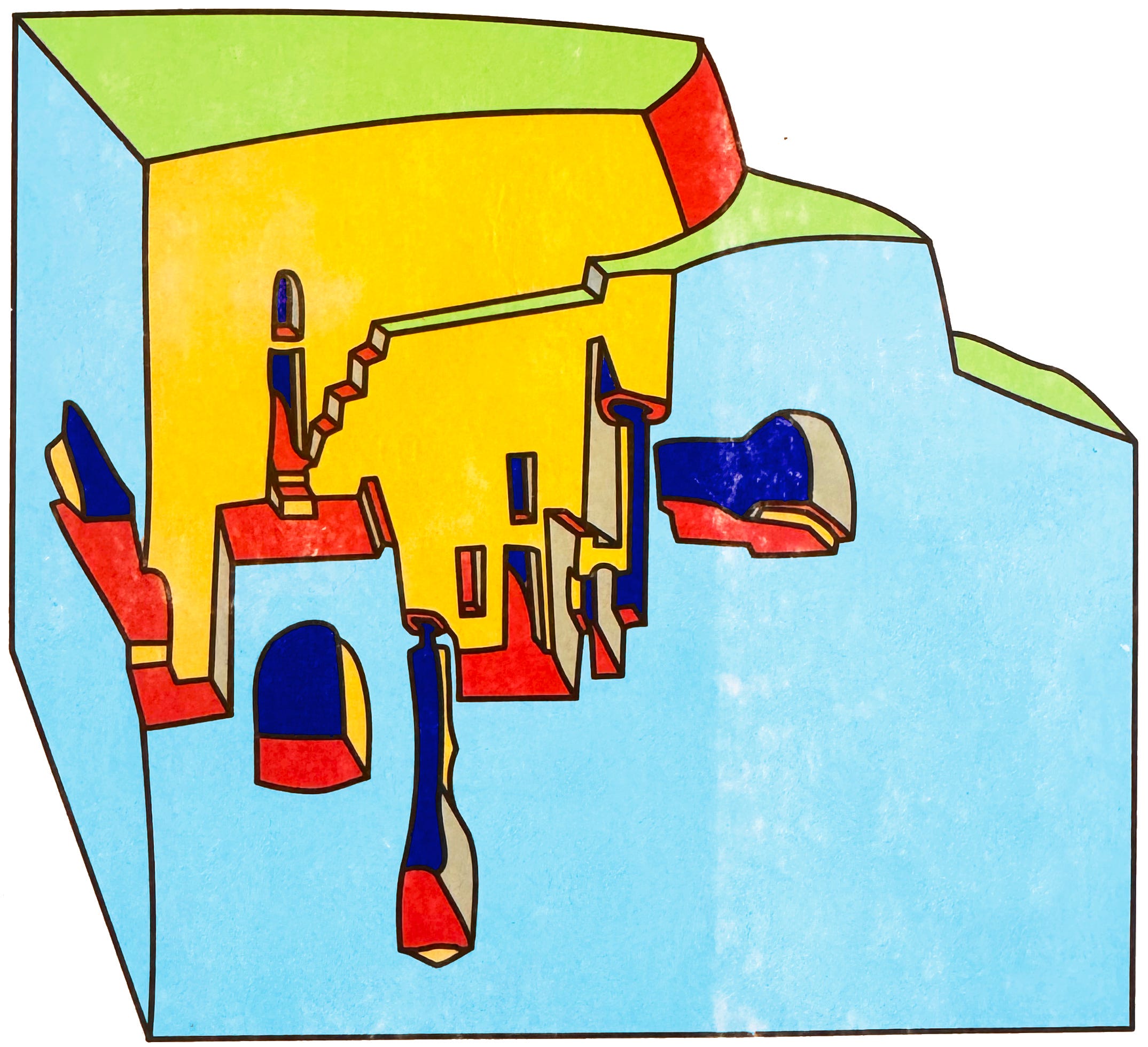
Illustration by Efthymios Warlamis.
Cave Architecture
The prominent architecture here is called Cycladic in reference to the group of islands where it thrives—The Cyclades. This fascinating style mixes geometric shapes with organic forms derived from cave-like shelters that were carved out of the cliffs, resulting in free flowing structures with nooks and crannies in dramatic settings that stir the imagination. Stoops, stairways, balconies and courtyards come from all directions, and are unencumbered by barriers that would ruin the view. Dwellings have various tiers where one person’s balcony is another person’s roof and so on. Many have pools that cling to the cliff’s edge or, better yet, built into a cove so that you avoid the mid-day sun but can still can soak up the view.
Back when “sustainability” wasn’t even a word, Cycladic builders were ahead of their time by erecting thick walls to stabilize temperature, made flat roofs to collect rainwater, painted everything white to reflect heat, and protected stonework from moisture and insects by applying a lime coating that is a natural disinfectant.
Originally created out of pragmatic necessity, the current day wealth derived from an endless stream of tourists on Santorini has meant that many of these humble homes have been transformed into charming shops, elegant restaurants and five star accommodations. While their hilltop setting was originally intended to provide early warning from pirate raids on the sea far below, now those high perches mean that every cafe, corner store and King’s suite has a glorious view. A labyrinth of paved pedestrian pathways weaves through each village, connecting properties, plazas and panoramas and turning every errand run and evening stroll into a scenic, magnificent feat of endurance.
Cycladica and slow living
One dreams about a trip like this for years. You search and scroll and plot and plan and ultimately cross your fingers that your feeble internet searches will translate into a worthwhile experience. Our good fortune led us to a cave home in the village of Oia, sourced from AirBNB, and hosted by a company called Cycladica. This lucky stroke equated to winning the lottery.
Our hosts were Laskarina and Yannis. She’s an architect who studied in Florence. He grew up on the island. They have expertly restored a few properties, and in the process created a lifestyle brand that exudes slow living. Quality over quantity. Savored experiences over instant gratification. Mindful details and minimal distractions over maximized luxury. Slower pace, less stress. The result is purposeful engagement, deeper connections, fulfilling consciousness.


In this case, that translated to a property that felt like a portal to another dimension. From the sun-drenched balcony, you entered the rock-hewn home with a heavy brass key that unlocked a medieval dutch door. The blinding light outside meant that it took a few seconds for the eyes to adjust. When things came into focus, the spacious interior was disorienting. There were no sharp corners, no right angles, just womb-like curves all around. An archway led to the kitchen. A gentle ramp to the bathroom. The shower was a cave within a cave. The second bedroom was down a level where you entered a gaping hole to the side of a living room by descending a few twisting steps that resembled a stack of marshmallows.
The style of furniture was somewhere in between Minotti and the Mos Eisley Cantina, and it complemented the space perfectly. A few shelves were curated with vintage books and magazines from the island as well as a booklet designed by the host which featured tips on where to find hidden gems around the island. There was Wifi, but nobody realized until well after we departed that there was no TV.
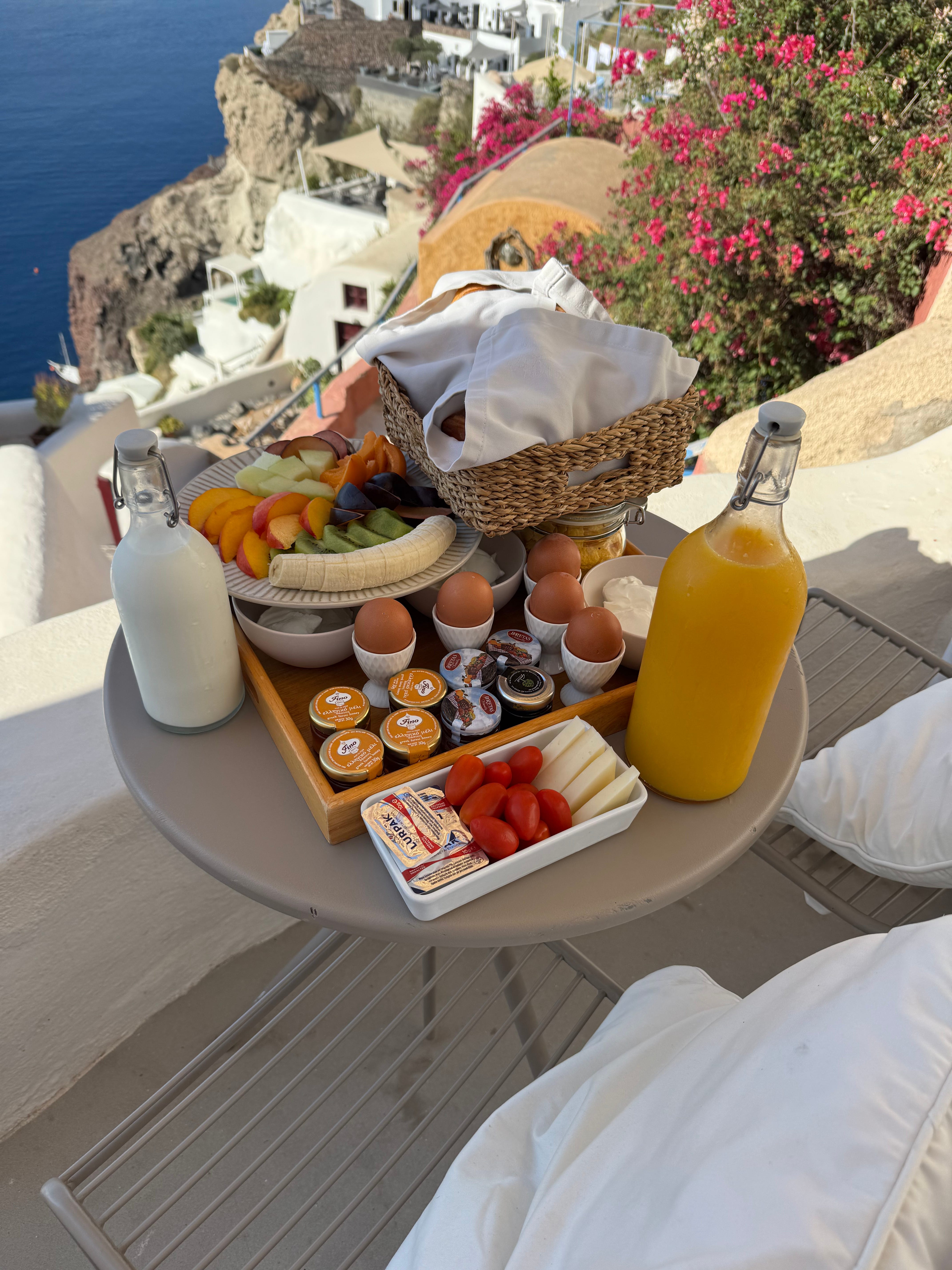
Breakfast appeared each morning like a renaissance still life. A large tray, delivered discreetly, with fresh fruit, yogurt, cheese, eggs, bread, cereal, juice and milk.
There was a fully-appointed kitchen, but no dishwasher. I knew that something as simple as taking my morning coffee on the breathtaking balcony would be worth the price of admission, but I never thought that hand washing a few dishes while staring at distant islands through a paneless window amidst a gentle breeze would be a highlight of my trip.
Each room overlooked the caldera and stepped directly out onto a patio which had multiple levels and arches and slopes and it was hard to tell where one property ended and another began. The kids scrambled onto the various tiers like cats on a cat tower. The most picture-perfect breakfast-ready table sat at the edge of the expanse, and a grotto-like shaded plunge pool tucked itself into a cove. Another level down featured porthole skylights, the hump of a dome and two more chairs. Stairways led up to various sunbathe perches. Ilias found a section that would later become an impromptu waterslide. And there was a third raised area that was flat and saucer like with two more chairs, no railings, and an unencumbered view across the entire expanse of the island. The sum of this put everyone in a state of bliss with little desire to venture beyond the sacred space.
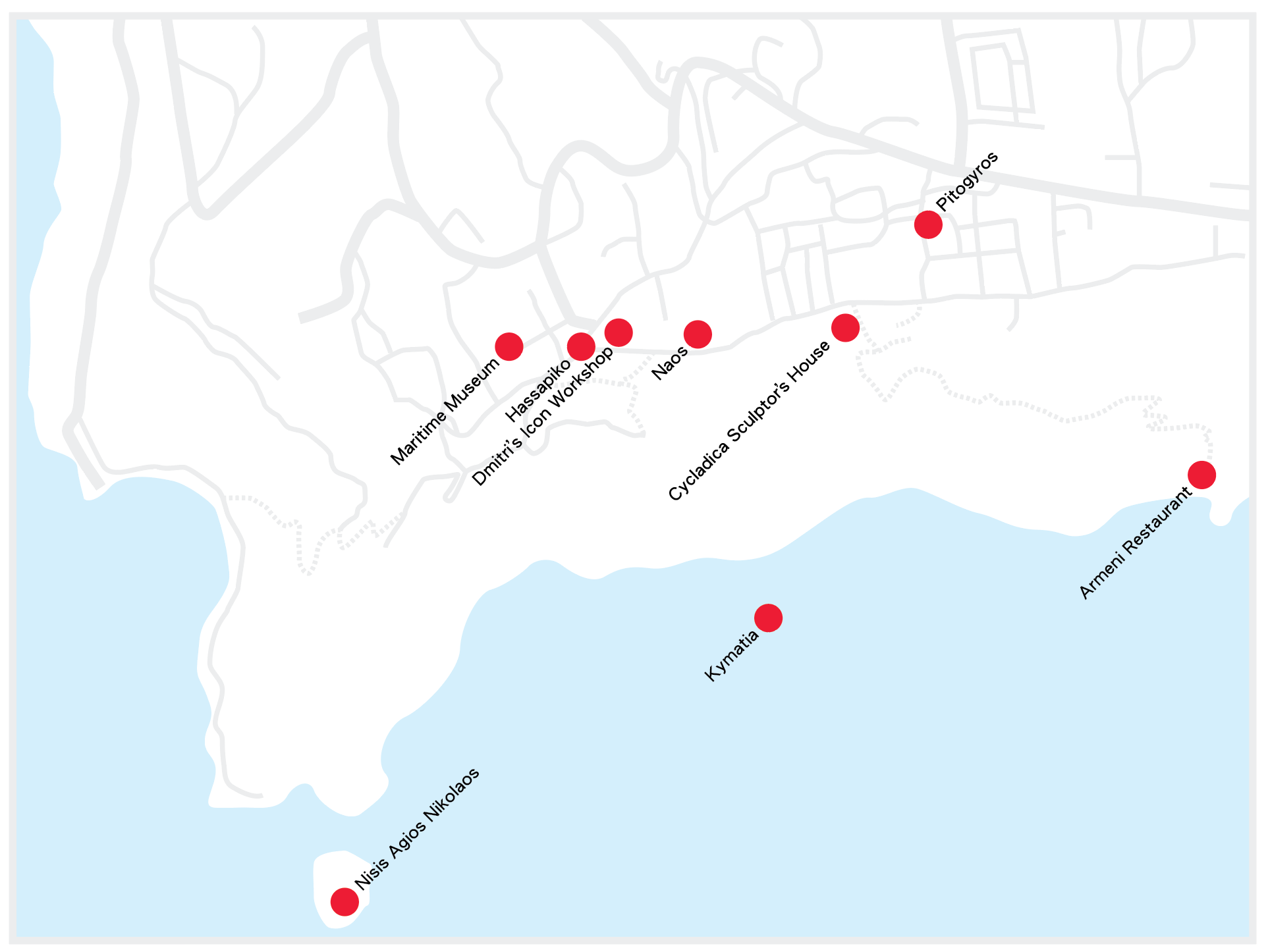
We eventually forced ourselves to venture further than the plunge pool. We rambled through Oia’s maze-like streets where every step felt like an adventure. Pitogyros served gyros that more than hit the spot. Hassapiko made nice cocktails. The maritime museum satisfied my craving for old maps. Dimitris Koliousis’ iconography studio was filled with treasures. We didn’t manage to find a restaurant that matched the splendor of the island, but there were plenty of great places to duck into for wine, cigars, ice cream, clothing and trinkets. But the most worthwhile excursion away from home was the Kymatia.
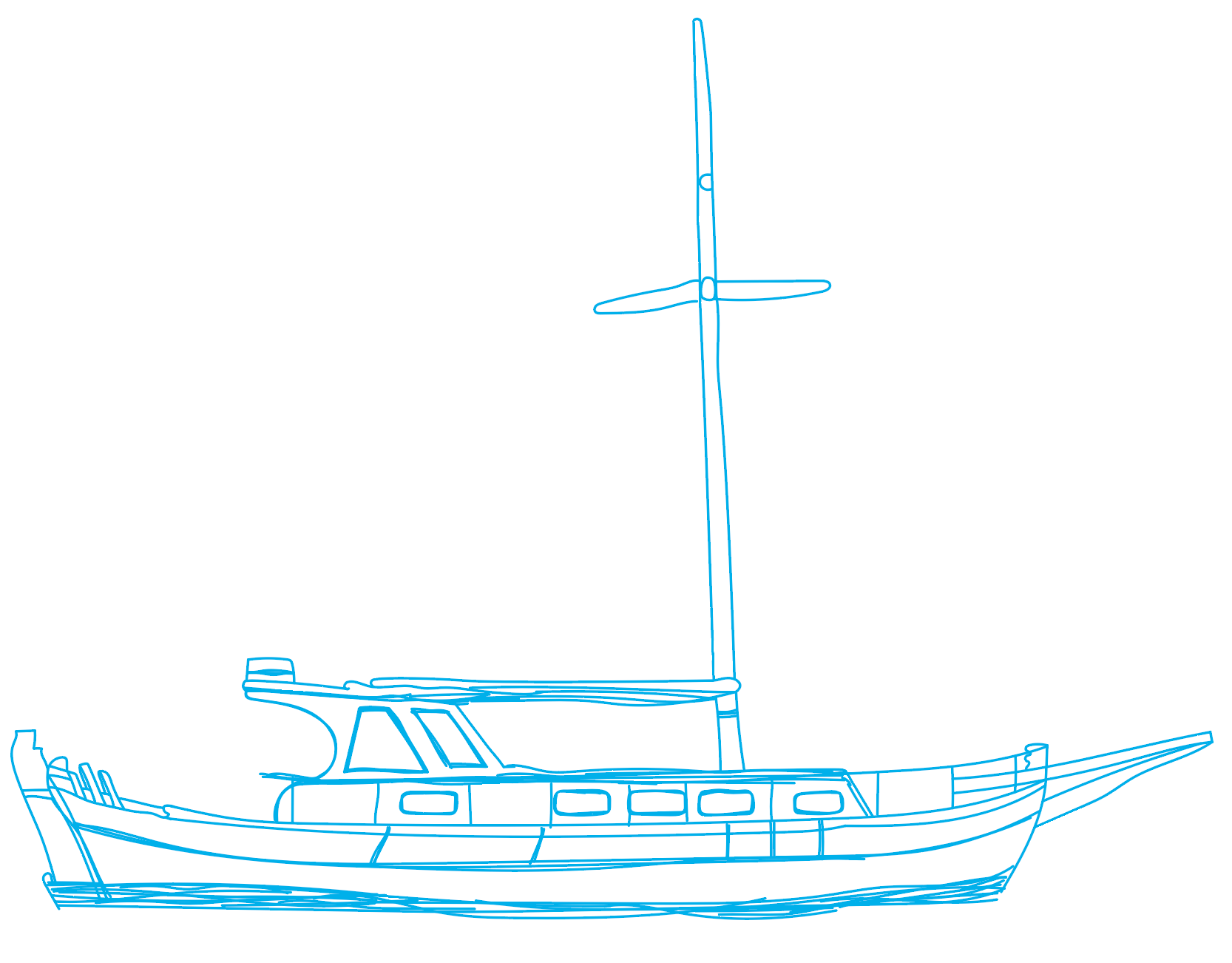
Caldera Cruise
A few weeks prior to arrival, our host asked if we were interested in trying their new boat out. They had spent a few years restoring a traditional Greek wooden yacht, and it was finally ready to charter to guests. We figured this would be a once in a lifetime opportunity and the day did not disappoint.
The fun started when we took the path from our house down towards the sea. A twenty minute hike to the seaside hamlet of Armeni offered glorious views at every turn. A tender awaited us with two shoeless, t-shirted, unshaven gents who invited us aboard for what at first had the feeling of a cordial kidnapping. I don’t know what I was thinking, but shame on me for expecting some sort of sharply dressed, buttoned up, “captain” who would offer stern pleasantries and keep a keen eye on the clock. Turns out, this was our captain and first mate, Yannis and Odie. And as I would soon learn, these were the two coolest, most capable, and most charming men in the Aegean.


We transferred to the larger, gorgeous boat named Kymatia. While nearly every other charter in Santorini is a modern catamaran, the Kymatia offered a much more unique and graceful experience. Of the various classes of Greek sailing vessels, I would guess this was considered a “Kaiki” which were typically built of pine, had single masts and ornate bowsprits, and were made for fishing or sailing. Below deck, there was a kitchen, bathroom and a few bedrooms. We were free to roam, and everyone quickly settled into their respective spots. The kids sprawled out on the large padded sunbed on the deck near the bow. Jen and I hunkered down near the bar in the stern where we could converse with the Captain.
The boat was ours for the second half of the day, and the itinerary was up to us. Kids wanted to swim and snorkel and beyond that it was just about taking in the views. First stop was to drop anchor in calm waters in between some of Europe’s newest islands—the volcanic remnants of Nea Kameni (“New Burnt Island”) which formed between 1707 and 1711 and Palea Kamani (“Old Burnt Island”) which formed in the prior millenium around the year 47.
The kids jumped in as soon as Captain gave the OK. He also handed out snorkel gear and a paddleboard. We approached Palea Kamani which had a sinister-looking cave we could swim inside. I gingerly emerged on the razor sharp, black lava rock shore. I sliced my hand pretty good on the way back and this led to the discovery of yet another talent of First Mate, Odie—he’s also a medic.
Some champagne and a few spritzes later, our next stop was anchoring close to a sheer rock wall of the main island. We were only about 50 feet from land, but the water was still hundreds of feet deep as the face of the crater continued straight down. This created an unbelievable blueness to the water all around us. Not sky blue. Not sapphire blue. Not Caribbean turquoise blue. This was a pure liquid cobalt. With the sun above us, any object that was in the water radiated a shocking cyan halo. It was like a reverse shadow where the underside of the boat seemed to hover on this lighter blue than the rest of the water around it. When looking underwater, the seabed was nowhere to be found and kids swimming 50 feet away where crystal clear.
Captain Yannis decided to settle here for a dinner, and no one objected. While Odie went below deck to magically whip up spaghetti with octopus, fried fish fillets, marinated zucchini, and a tomato salad, the rest of us dove and bobbed and relished the surroundings. This cathedral-like corner of the caldera was the perfect backdrop for a family meal. When dinner was served, every member of the family seemed to relish the moment because nobody showed up with phones, nobody fought over seats, nobody complained about the menu. Conversation flowed. Plates emptied. Glasses re-filled. And eventually the anchor had to be reluctantly reeled back into the boat.
The beauty of a boat like this is that we can go where we want to go, and for the final leg of this journey, we set course for the sun.
They sky turned from tangerine to lavender as our bare feet dangled over the bowsprit, tickling our toes with spray.
Odie pointed out the church on the tiny islet that he and his classmates would swim to every day after school like some sort of mythological version of Stand By Me.
We gathered for crew and family pics in the golden light, and every one of us realized we were experiencing a day of days.
The sun came and went. The sky was now dark and the encore of this excursion topped everything that came before it.
Above us, the lights of the towns atop the towering cliffs hovered mid-sky like mini galaxies you could reach out and grab.
When we reached shore, there was relief not because the journey was over, but because we knew we all experienced something we can reflect on for the rest of our lives.

A 1500 passenger cruise ship sank in Santorini in 2007 and is still sitting there underwater. Almost twenty years later, oil and fuel from the wreck is still slowly drifting to the water’s surface.
Atlantis Books is a remarkable book store overlooking the caldera in Fira that was opened on a lark back in 2002 and is still going strong.
Meet Sostis, the former solitary inhabitant of Palaia Kameni
In case you missed it, here’s the Sculptor’s House we rented in Oia on Santorini.
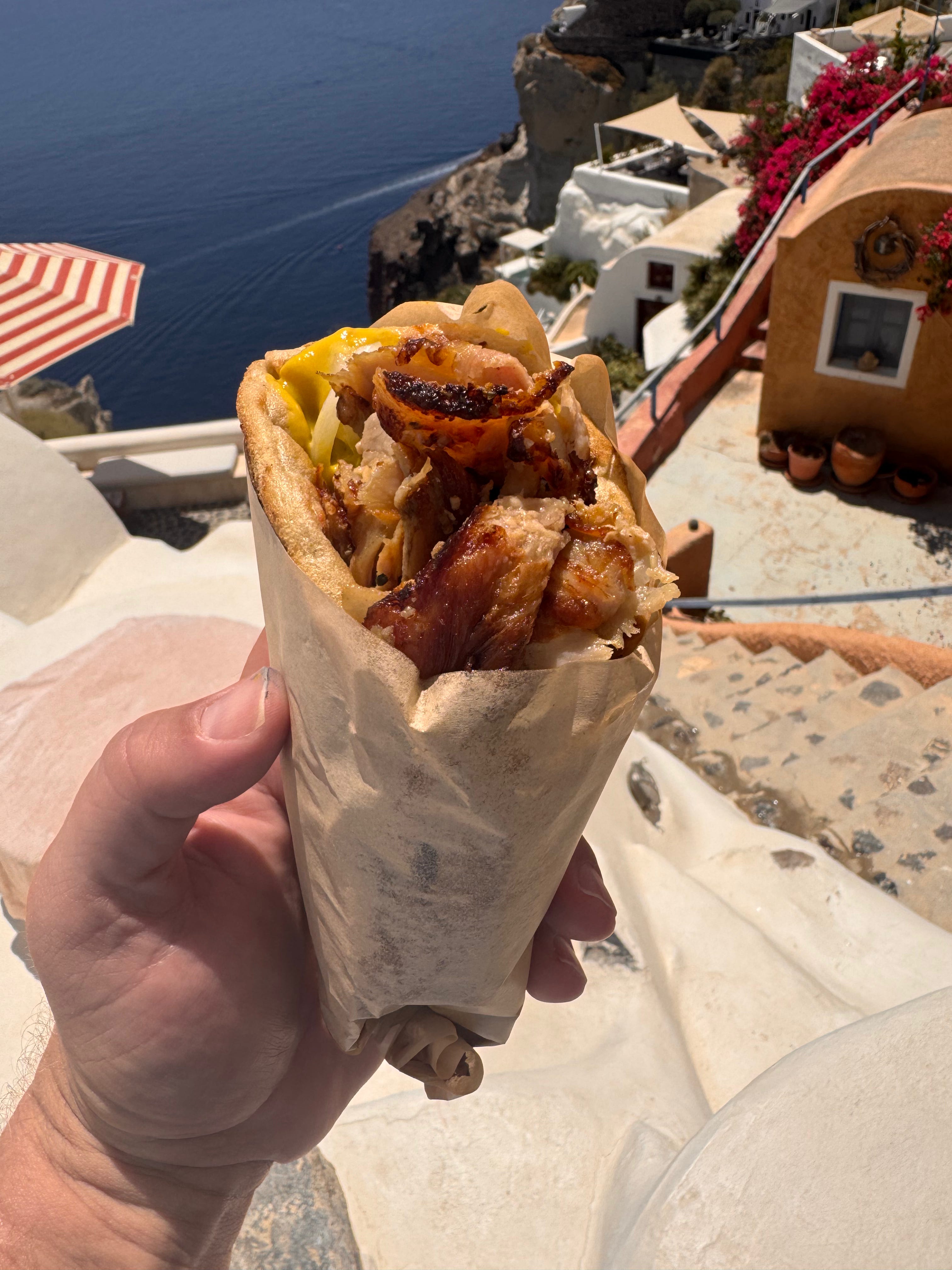
Gyro - The “Old” One
The Greek version of the humble but iconic gyro sandwich is worth daydreaming about, and pretty much anywhere you encounter the spinning shrine of melting meat you will find that it is every bit as good as you imagine. Perfectly warm and puffy pita bread wraps like a blanket around freshly shaved slices of marinated pork which have been slathered with a refreshing splash of the Pimms Cup of condiments—tzatziki—and stuffed with a bouquet of sliced tomato, onion, and freshly fried potato spears. In the town of Oia, the bustling Pitogyros restaurant offered numerous variations on this classic, one of which caught my eye—”Gyro, The Old One.” This version used a base of slice pork, tomato and onion on pita bread, omitted the french fries, and most notably, swapped the tzatziki for mustard. The end result was reminiscent of putting mustard on a hot dog and still hit the spot. A simplified classic for the ages.